Kimberly Ruffin is a Certified Nature and Forest Therapy Guide who leads walks and gives talks in the Chicagoland area and wherever else she is called to serve. She is the author of Black on Earth: African American Ecoliterary Traditions and Associate Professor of English at Roosevelt University.
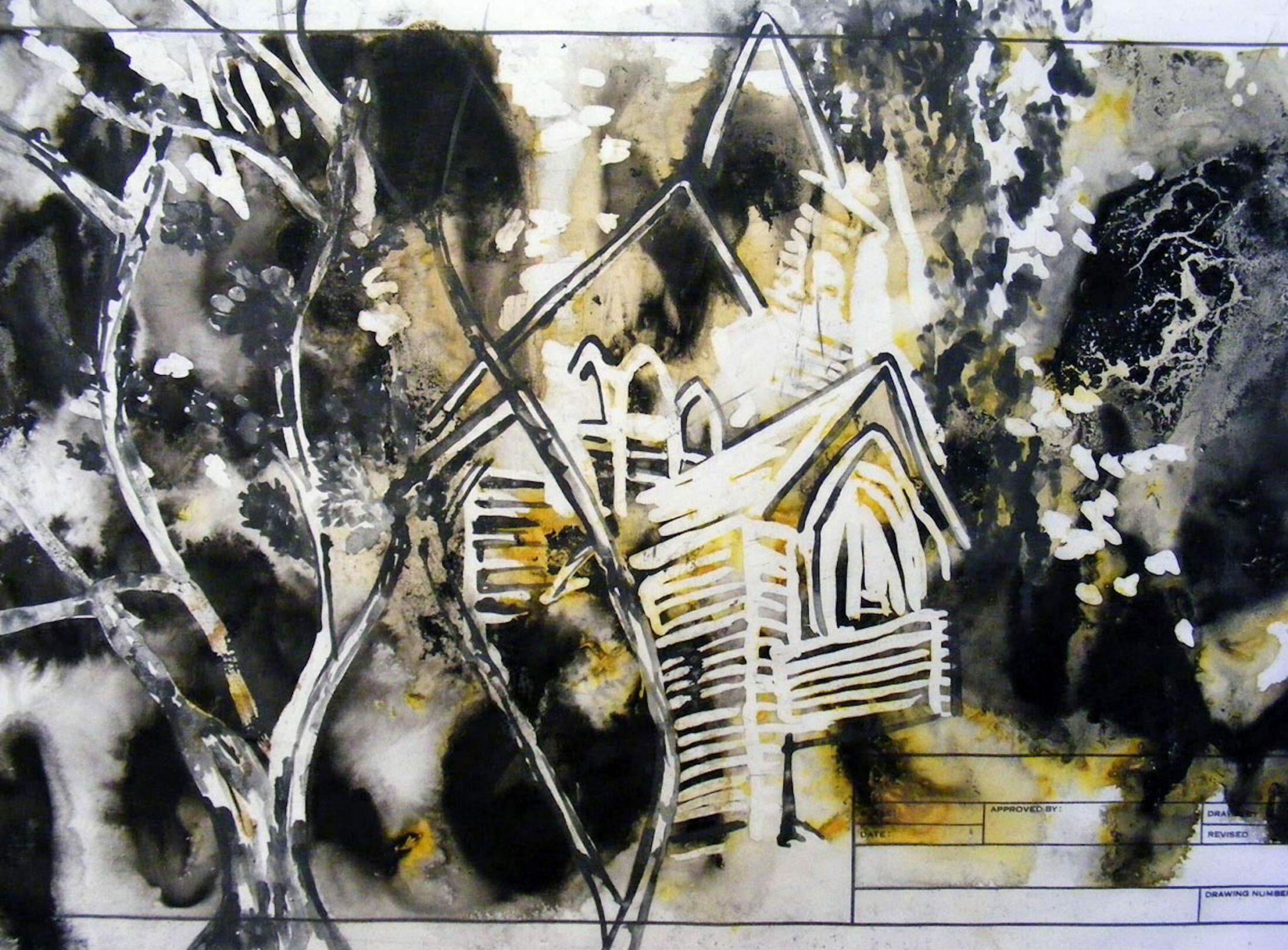
Dawline-Jane Oni-Eseleh is an Oakland-based visual artist whose current work is focused primarily on the shifting urban landscape. An avid observer and photographer, she uses a range of media in her work, including relief printmaking, pen and ink, photo transfer, and encaustic.
As Kimberly Ruffin revisits her upbringing and spiritual heritage, she compiles the bodies of evidence that have invigorated her spirit. She explores where “spirit power” can be found, both within a church community and in the places where faith rises up within the land.
Mama, you win. I joined church today. You and Aunt Louise said it would happen, and sure enough, here I am, a Certified Nature and Forest Therapy Guide with a church home. It’s not because I found the Truth, though. Not sure I need that anymore. It’s just that, when it comes to belief, the phrase that feels right to me instead is “body of evidence.” I’m a church member and forest therapy guide because, in my life, there are two bodies of evidence that are compelling and undeniable.
Getting here wasn’t quick and easy, and if I’m honest, I don’t know if this is my final destination. Even if it isn’t, I am going to hang out here awhile. My spirit feels good in my body. There have been lots of twists and turns on this faith-journey. I’ve wrestled with being both a Christian with more interest in earth than heaven and a firm believer in religious pluralism who knows that an earth-based religion would not be enough for me. Free from finding the one and only “TRUTH” in a religious doctrine, I know faith is my evidence-based real thing. Faith is the method we use to support the spirit of our human animality. It’s what fills us up, keeps us ready, and calls us out of the grayness of a Chicago winter. Poised between two bodies of evidence, I’ve found my faith. Nature is my church, and church is in my nature.
As a kid, I learned about the outdoors as a faith fact through my elders, my mom, and my little life. On my dad’s side, seared in my memory is my cocoa-brown elders’ skin glistening in the sun as they relaxed in the ecological wealth of their minimalist North Carolina farm home. Deep peace from a life lived close to the land emanated from their hearts and their faces. Grandpa Rufus, a collard green wrangler, grew a garden on his small city plot into his nineties. Mama’s the baddest self-trained landscape artist in the Chicagoland area. And I had a bike and a “go outside until dinner’s ready” kind of childhood. I learned that the outdoors is where important stuff happens—you would want to be out there.
The church is one of my faith facts too. This body of evidence was built by Black folks. Wherever we lived in my Navy-brat childhood, from Virginia to California, we went to church. Sometimes it was a church on a Navy base with a chaplain, orange juice, White people, and lots of guitar. More often, it was a Black church with a gospel choir and long sermons peppered with call and response. Mom looked extra hard for the Black churches, and now I see why.
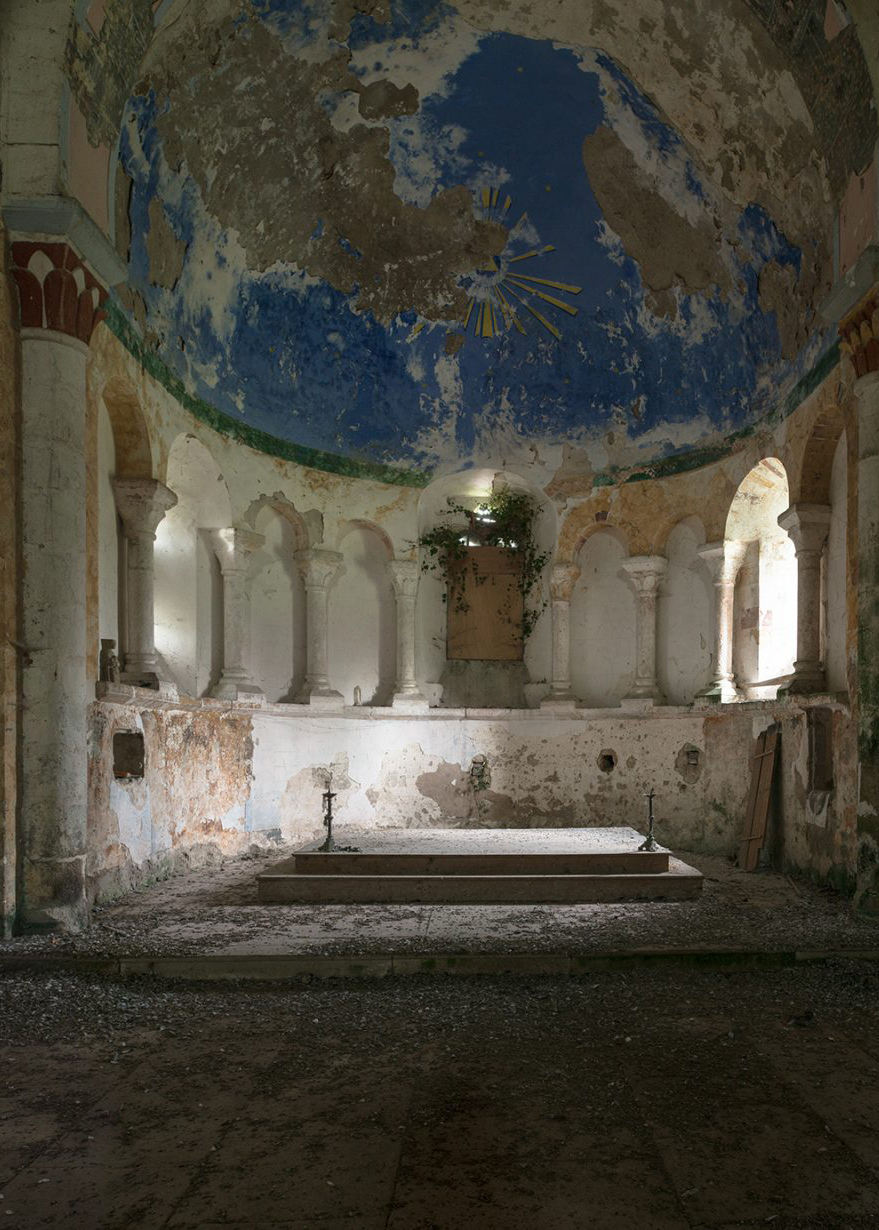
Even if they don’t comprehend all of a minister’s exegesis, squirmy kids in the pews with crayons in hand get exposed to the human culture a church supports. Black churches are usually a direct pathway to places where our humanity is not in question. Little babies come under this protective covering and have neuropathways formed in a place where church ladies and gentlemen smile at you and a congregation awaits your performance in an Easter play. Even those no-nonsense ushers look at you with eyes that seem to say, “Yeah, you belong here, but you betta sit down where you’re supposed to” and “No, you can’t come in yet; it’s time to pray. Hands this way.” Black women and men in authority transforming congregations through word, deed, and song. Spirit power. Brenda Dixon Gottschild explains, “The spirit power in a traditional black church service is generated by the active body-and-soul participation of the communicants. Spirit stirs voices to shout spontaneously and moves bodies to stand, stomp, or wave lifted arms.… All emergent manifestations of spirit are embraced, and waiting arms catch the enraptured ones before they fall, just as consonant voices join in with the person who shouts ‘Hallelujah!’ or ‘Yes, Lord!’ Spirit heals soul and reinvigorates soul power.”1 Black, spirit-filled bodies made strong. Any nonsense about Black inferiority in racist, sexist America thrown at my mind was deflected off the walls of the Black church. Tenderness and opportunities to grow were there and, yes, some boundaries too.
Nature is my church, and church is in my nature.
My teen years were filled with “Controversy” and lots of other nasty Prince music. (Prince knew his Bible though, especially that Song of Solomon, the sultriest book of the Bible.) I was questioning things constantly. Lord knows what my Sunday School teachers endured. Atheism seems to have a tinge of truth, but absolutely no Spirit. Rants and righteousness, yes, but no good music. Bummed out by the feeble expressive culture of atheism, I kept searching. I went way out there. But that “Jesus was a Vampire” sticker in my spiral notebook … well, I don’t blame that on nobody but my buddy Marybeth. Sorry, Mama, I didn’t mean it. Dad, thanks for saying Mom shouldn’t have been looking in my makeshift diary no way. I was just searchin’. I was a nerdy, New Wave teenaged kid in 1980s, Boy-George-inspired fashion, pushing boundaries and going every Sunday to a Black church that put up with me anyway. I left my teen years with an understanding of Christian fundamentals, church culture, religious pluralism, and questions about where exactly to put my faith.
Faith is so necessary, because supporting your human animality as a Black person in this day and age is no joke. You’ve got to deal with the cards dealt to other modernized, urbanized, digitalized, and globalized human beings on a planet that’s warming up and flooding at the same time. Then, you got to deal with this heap of hot mess from other people: racism, sexism, colorism, heterosexism, classism, ableism, and ageism. Anytime, any-damn-where, this shit can pop up on you, especially in this age of tRump. Monkey “jokes” and blackface STILL making the rounds among these idiots. Every racist White person thinks they’re deputized to police Black folks doing anything. Every Black woman I am—and every Black man I love—at risk. As Taryn Finley’s “Existing While Black” online series shows, we’re surveilled shopping, working, driving, talking, walking, moving, sleeping, waiting, parenting, having fun, fishing, selling, and eating.
We’re going to need any and every life-giving nature practice we can find to turn this ship around.
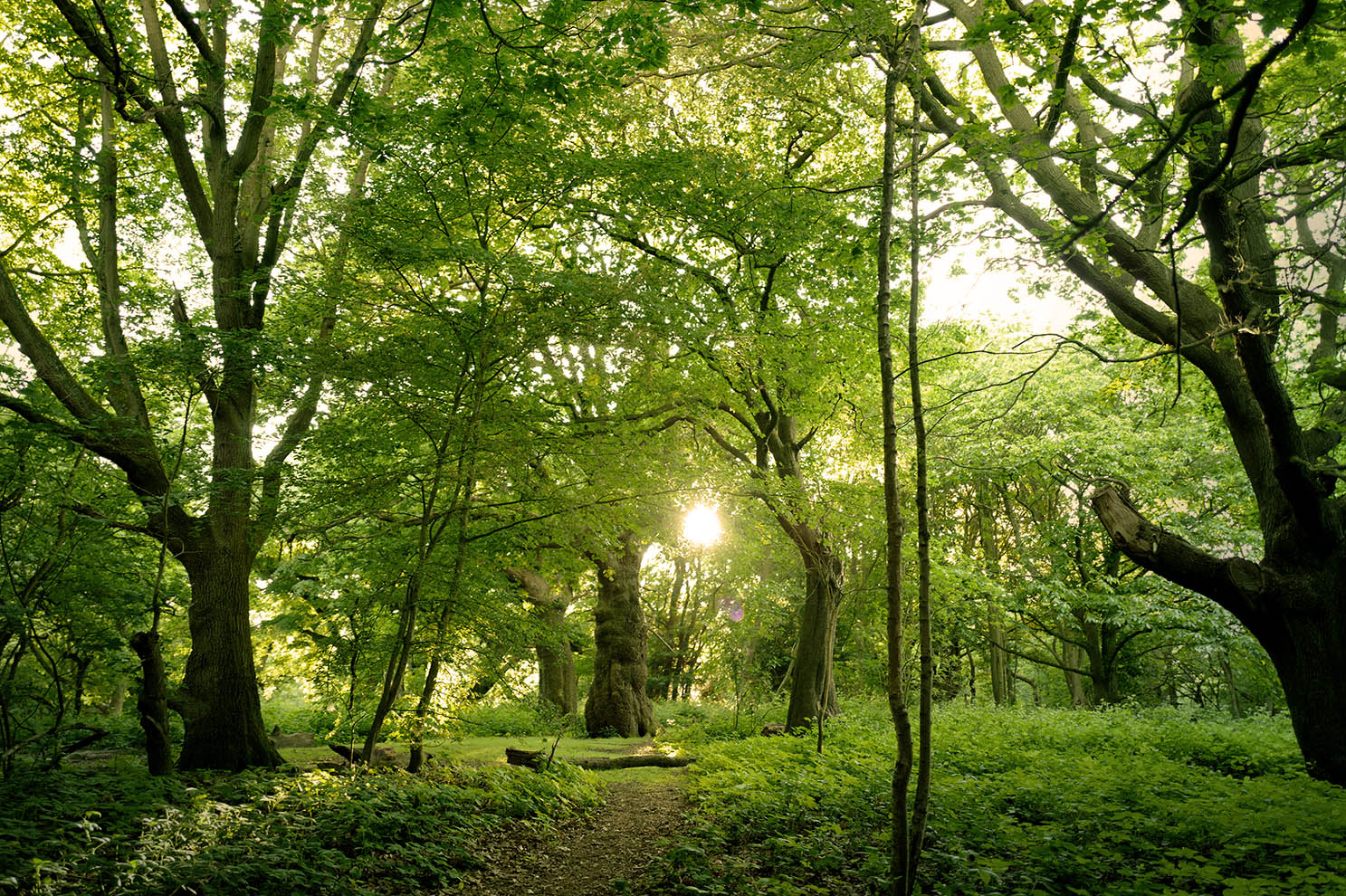
Since I’m a new member at my church, I’m gon be quiet about the forest therapy thing for a while. This will give me more time to check out the scene and see how the two parts of my faith might come together. For now, I’m mighty happy just having each of them on their own. Forest therapy came at a time in my life filled with midlife disappointment and an overreliance on a cerebral connection to nature’s delights. I had grown weary of one wing of American nature practice that was starting to feel a little ascetic: silence, stillness, and solitude. (Picture John Muir in rain-drenched clothing perched in a tree during a windy storm.) While I respected the need for any of those things on occasion, I longed for something more. Forest therapy gave me more, in the nick of time. It’s a Western take on the Japanese practice of “shinrin-yoku,” which is translated in English as “forest bathing.” The worldwide scientific community is accumulating an impressive body of evidence on its effectiveness in supporting human health; however, I know firsthand that it works. Focused on inviting sensory connections to nonhuman nature through easy-paced group walks, it’s complementary with the best of what I’ll call Black nature practice: dance, song, and all-a-y’all. Steppin’ under the stars at an outdoor dance festival, camp meeting sing-alongs, and somebody else out there besides me, ‘cause you don’t know ‘bout these racist folks and people who mean you harm. Like Native American hip-hop artist Supaman said, “The power of the song is shown through our movement and connect[s] us with the earth. Dance like everybody’s watching.”